IBION-TEC
 The Course Biomolecular Engineering and Nanobiotechnology (IBION-TEC), an engineering program specializing in nano- and biotechnologies, enables students to acquire skills at the intersection of biology, physics, electronics, and chemistry. This program provides a broad foundation of skills, as well as highly specialized training in the field of biomolecular engineering focused on detection and diagnostics. It trains students in innovative techniques in nano- and biotechnology, leading to a recognized degree in these emerging fields that will have a lasting impact on our societies. Our students go on to lead R&D projects in private companies in the sector (pharmaceuticals, cosmetics, and food) as well as in major research institutes.
The IBION-TEC Master’s program emphasizes the design of innovative tools. To this end, a workshop space is available to students, allowing them to develop and design their own technology projects throughout the two-year program. Students will have access to various technology platforms in Montpellier and to a fully equipped lab on our university campus. The goal is to collectively produce proof-of-concept demonstrations and develop prototypes based on projects preselected as part of our annual competition.
Second-year students will be responsible for organizing, entirely on their own, an annual conference sponsored by their BIOTRACE Association.
Citizens’ quality of life, the safety of healthcare, product safety (particularly food safety), and environmental conservation within the context of sustainable development are all key issues at the heart of IBION-TEC’s training program.
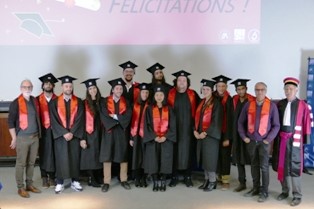
Graduation Ceremony for the Class of 2018–2019

Expertise and Skills
This program provides a pathway to careers in both the business world and research. Careers that stem from this program include:
- Design Engineer in Diagnostics and Detection
- Traceability Management Engineer
- Head of the Testing Laboratory
- R&D Project Manager
Types of jobs available beyond strictly technical skills:
- Production Manager
- Wastewater Treatment Plant Operations Manager
- Research and Development Engineer
- Traceability Management Engineer
- Dental Hygienist
Course Layout
First Year of Master's Program
The first year of the program (M1) is primarily devoted to the initial development of the innovative project that forms the foundation of the program. The 5-month internship rounds out the M1 program with a first hands-on laboratory experience. The M1 year is dedicated to acquiring the fundamentals of nanotechnology.
Semester 1
TU Required:
- Biostatistics with R(5 ECTS)
- Immunotechnology (5 ECTS)
- Preparation for the Internship and Career Transition(2 ECTS)
- Protein Bioengineering for Traceability 1(3 ECTS)
- Interdisciplinary Interface(6 ECTS)
- Innovative Project 1(3 ECTS)
TU Optional:
- Option 1: the following two courses TU (3 ECTS each):
- Choose 2, 2 TU (3 ECTS each) from among:
Semester 2
TU Required:
- New Generations of Analysis(5 ECTS)
- M1 Internship(12 ECTS)
- Innovative Project 2(3 ECTS)
- Interdisciplinary Interface 2(4 ECTS)
- Project Management(3 ECTS)
- Pollution in Agro-Environmental Systems(3 ECTS)
M2 Year
The second year (M2) is devoted to organizing the annual BIOTRACE conference, which focuses on communication and collaboration with the professional community. The M2 marks the completion of an innovative project: students have two weeks to conduct experiments leading to a proof of concept or feasibility study. The 6-month internship provides professional experience aligned with the student’s career goals.
Semester 1
TU Required:
- Project Management and Conferences(3 ECTS)
- Bioinformatics(3 ECTS)
- Sensors and Instrumentation(3 ECTS)
- Innovative Project 3(11 ECTS)
- Biosensors and Microdevices(2 ECTS)
- Formulation of Biopharmaceuticals and Biomaterials (3 ECTS)
- Nanotechnologies for Health (2 ECTS)
TU Elective courses: 1 TU , worth 3 ECTS, chosen from among the following:
Semester 2
TU Required:
- Protein Bioengineering for Traceability 2(2 ECTS)
- Entrepreneurship and Business Development(2 ECTS)
- Design and Implementation of R&D Projects(5 ECTS)
- M2 Internship(21 ECTS)
Partner Laboratories
The program is based on a proven partnership with two engineering schools in Montpellier—Institut Agro and Polytech—as well as with the UMR research units QualiSud, IATE (Agro-Polymer Engineering and Emerging Technologies), IPSiM (Montpellier Institute of Plant Sciences), DIADE (Plant Diversity, Adaptation, and Development), PHYMEDEXP (Physiology and Experimental Medicine of the Heart and Muscles), M2A(Materials, Microsensors, and Acoustics at the Institute of Electronics), European Institute of Membranes in Montpellier, IRCM (Montpellier Cancer Research Institute), Institute of Pharmacology and Innovation in Diabetes.